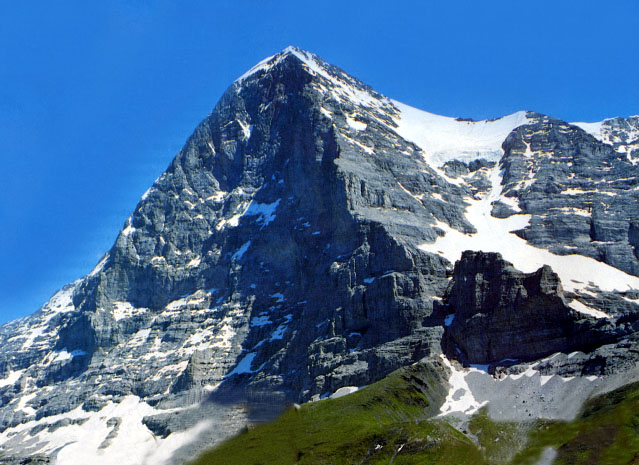
Perched high in the Bernese Alps of Switzerland stands ‘the Eiger.’ 3,970 meters of rock and ice dominating the skies above the valleys of the Bernese Oberland; Switzerland’s inhabited highland region.
 |
| Flag: Berenese Oberland |
A black eagle soars proudly on the Oberland’s flag, symbolically representing courage, strength and farsightedness. It seems fitting that the region’s flag should possess such powerful imagery; traits to be maintained by every climber who attempts to conquer its limestone buttress.
Having scaled Mont Blanc and the Matterhorn before that, “we needed another challenge,” says Keith Kearns, a 51 year old mountaineer from Lincoln, United Kingdom. “There was only one mountain that fit the bill.”
Since it was first scaled in 1858 by Charles Barrington, an Irish mountaineer from County Wicklow, the Eiger’s become somewhat of a legend earning a firm footing in popular culture. A 1972 novel titled ‘The Eiger Sanction;’ later turned into a movie starring Clint Eastwood, is an example of a common factor that appears within many adaptations of the Eiger’s history - its death count.
Since 1935 it is estimated that sixty-four climbers have lost their lives whilst attempting to surmount to the challenge of ascent.
Whilst crossing a very difficult section on their climb along the Mittellegi Ridge, a member of Keith’s team became stuck. “I had to wait for half an hour in a very narrow chimney of ice. I only had the tips of my crampons for support and I began to lose feeling in my feet.”
As I ask him about the thoughts that were running through his head as he remained dug into the ice, with no more than two, inch long spikes of hard steel between security and an uncertain fate, I question my own nerve should I have found myself in such a position.
“The right mind-set is all important.” He tells me. “At times my body was protesting and my calf muscles were screaming, but giving up was not an option.”
 |
| Mittellegi Ridge |
At approximately 1500 meters, the earth’s atmosphere begins to decrease and oxygen levels become thin. Breathing gets deeper, the heart beats faster and blood pressure rises. Taking the time to acclimatise to these drops in atmospheric pressure can prevent illnesses such as acute mountain sickness and high altitude cerebral or pulmonary oedema.
However, for this group of climbers there was no respite of altitude training; something which had always been a precursor to their previous expeditions. With the treacherous weather moving in at speed, the opportunity for a safe ascent was disappearing.
“We arrived on a Saturday evening but we had to begin our climb on the Monday and Tuesday. After that, the heavy snowfall and the very real threat of avalanches made the risk of waiting unacceptable.”
An experienced mountaineer; Keith knew that the lack of acclimatisation would have repercussions.
“I could not sleep at all on the first night. I completely lost my appetite and every step I took felt so much harder than before; talking whilst on the move left me breathless.”
Fortunately, his experience had taught him to remain calm and focussed until his body began to slowly grow used to the altitude.
When we are asked to imagine a mountain, a typically generic image springs to mind: a snow covered tip which juts out above the cloud, a misty fog shrouding the summit in an air of mystery. For someone like myself, having never attempted to climb a mountain, I ask Keith what makes the Eiger different from any other.
“All mountains are different” he says from his kitchen table, his certificates and photographs of past expeditions proudly lining the walls of the hallway.
“They all involve different levels of skill, sometimes only on one or two tricky sections. Not the Eiger, that was full on from start to finish. At times it was beyond any climbing I had ever done before.”
 |
| North Face |
“Total concentration is needed at all times. Exposure, especially above the North Face would have severely punished even the smallest of mistakes.
As he recalls the experience, the tone in his voice changes as the topic of conversation turns to the infamous North Face.
It is this route, visible by telescope from the ‘Kleine Scheidegg,’ a pass between Grindelwald and Lauterbrunnen that has claimed the majority of the Eiger’s fatalities.
In 1935, two Bavarian climbers were found frozen to death at 3,300 meters on a part of the face which was morbidly dubbed ‘The Death Bivouac.’
It stuns me how such horror stories do not deter even the most hard-nosed mountaineer. The answer, according to this experienced adventurer, is simple. ‘It’s the feeling you get when you reach the summit.’
“It’s a feeling of elation. As we neared the summit my muscles stopped protesting almost immediately as the adrenaline began to kick in. It was hugs, kisses and high-fives all round.”
The photographs that line the walls of his house are testament to such an admirable achievement.
The views and the emotion encapsulated within four corners of a photograph allow you to imagine the feelings shared by the lucky few who get to experience the panoramic views first hand.
I ask Keith where his next adventure will take him: “Something a little easier, perhaps.” he says, smiling.
“I’d love to go climbing in Slovenia. The ‘GR20’ in Corsica is also on the back burner, as is a desert trek in Jordan.”
By Benjamin Yates
Sidebar -
The Eiger is situated 5.5 km northeast of the Jungfrau (a summit in the north-eastern Bernese Alps.) The same distance to the north is the village of Grindelwald; a popular skiing destination.
 In July 2006, the Associated Press reported that a large section of the eastern face of the Eiger fell away from the mountain landing in an uninhabited area. The incident which lasted for 15 minutes saw 20 million cubic meters of rock sheer away. No one was injured.
Medical definition of oedema: Accumulation of excessive fluid in the brain (Cerebral) or the lungs (Pulmonary)

 A Morrisons spokesperson said: "We have a strict 'Challenge 25' agenda which we uphold throughout our stores".